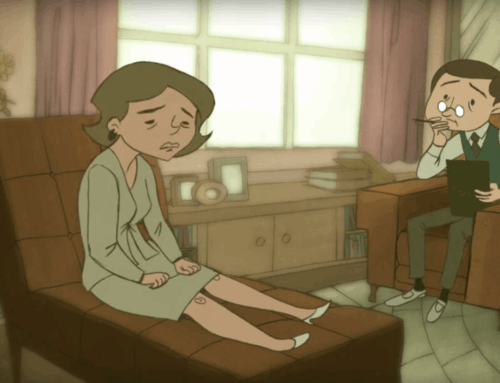

What if I told you we were already isolated?
Caroline Gouvêa S. Wallner *, text written during the Covid /19 Pandemic.
New Edition in 07/2025
It was a house with no people inside. Each person was in their own room, without looking, without talking or noticing the other person who was in the same room.
In the daily acceleration and the “dictatorship” of constant production of success, human beings have become alone, isolated in their own world, careless with their habits, helpless in their own private world.
People arrived home from work tired, exhausted and with no time for each other in their own homes. That moment of sharing and socializing at home was no longer happening, and the space of isolation grew.
In restaurants, parks, and social settings, there were people, but they were far from each other, each in their own private world on their cell phones. Physically disconnected, but “connected through a wall called a “screen”. The production and image of success cannot stop! This speech was echoed in all environments. Places, spaces, without people inside!
Time has become liquid, fast, accelerated like the speed of the internet, this was also heard everywhere: time is passing faster and faster!” Really? Social ties are increasingly volatile, immediate, instantaneous and fragile. Constant dissatisfaction. Let’s remember the slogans: “the dictatorship of happiness”; “it is forbidden to be sad, to fail, to take breaks, to rest or to slow down”.
This “dictatorship of success” echoed and was reflected in the level of anxiety and stress.
Human beings have become ill, trapped and alienated within themselves without considering others, with and as a time to look and listen.
And in the middle of this already intense and accelerated path , as well as disconnected, a viral disease appeared that determined that people had to stay indoors – that house without people inside – with a reduction in those activities of the “insane rush focused exclusively on production”. A time to look at the other beyond oneself. A time to connect.
Was it experienced by many as a stumbling block: a discomfort, a suffering, a “forced” time to think about life?
What are we doing with our lives? Why does the imminence of real death cause so much discomfort?
Perhaps because it is something unknown, even if we have already experienced death at some point in our lives. It will always be a new moment, causing helplessness, and we often have no psychic resources to help us, and we are unable to capture the real record of death to prevent, in advance, the discomfort generated in the attempt to avoid encountering pain. And coming into contact with pain directs us to our internal spaces of emptiness and isolation. But which space each person will follow depends on each individual, and some may panic and despair. Panic occurs when the individual unexpectedly encounters the dimension of loss and finds themselves without internal psychic symbolic resources. It represents just one of the many possibilities for the individual to relate to their own helplessness, in an extreme effort of pre -symbolization, as it anticipates the experience of dying – as an imaginary representation of entering into death itself.
Freud (1926/1975d) places helplessness far beyond an accidental and traumatic condition or as a regression to a primitive state of psychomotor insufficiency. For him, helplessness refers to a fundamental lack of guarantees for the functioning of the psychic apparatus, since it is incapable of promoting a definitive symbolic apprehension of fundamental issues of the subject, such as death itself, destiny, etc. In the symbolic order itself, there is something that is fragile, but that, paradoxically, opens up to the world of possibilities, from which the subject can constitute himself. Despite this gap, the symbolic law can be exercised in such a way as to meet the minimum conditions necessary for the subject’s well-being. We believe that, in panic, due to the helplessness in which the subject is submerged, this fragility takes on excessive proportions which, for this very reason, leaves him helpless.
The way to deal with discomfort is individual and particular to each person. Each person will activate psychic defense mechanisms according to their life history, their relationship dynamics with the internal and external world, added to their particular way of functioning.
Freud conceptualized the symptom by listening to his patients’ complaints. It was a medical, curious look. He concluded that the symptom was not a sign of an illness , but rather a particular form of expression of a psychic conflict . The symptom gained the status of a formation of the unconscious. Like a message to be deciphered, a sign that can be interpreted, renamed, symbolized and even “cured” in the sense of relational transformation (the self and the other). The symptom is something that repeats itself and that the person often cannot overcome on their own, complaining of something that causes suffering, but feels connected to it, “it is stronger than me”. For Freud, symptoms have a meaning and are directly related to the life of the person who produces them.
Anxiety manifests itself in the form of “a realistic fear, the fear of a danger that was really imminent or that was judged to be real” (Freud, 1926/1980, p. 131). Anxiety is the reaction to this danger and the symptom is created to prevent the emergence of the state of anxiety. The formation of symptoms, in this way, puts an end to the dangerous situation . Anxiety is, therefore, a reaction to a dangerous situation . The reaction of anxiety signals the presence of a dangerous situation , and it is to escape this dangerous situation that symptoms are created. The Freudian conviction is that symptoms have a meaning that can be deciphered like other formations of the unconscious ( it is a psychic and symbolic elaboration, whose form depends on the psychic inscriptions, or unconscious memory , in a subject).
The symptom is expressed through language, it can appear in speech and in the body, in actions, and through interpretation it is possible to approximate it, thus evoking its semantic resonances. The analytical treatment is then oriented towards freeing the repetitive insistence that exists in the symptom and the truth that is hidden there.
Since the time of poets and philosophers, we have discovered that we become ill through words, spoken and silenced, and that we can also transform ourselves through them. Over time, there has been a deepening and development of techniques with methodologies and the legitimization of care and management of symptoms through words that touch the body.
The WHO updates the number of cases of illness and deaths across the planet daily. These people may or may not develop anxiety and depression disorders. It is not something predetermined, if this then that.
Let’s remember the stress and isolation mentioned at the beginning of the text, also caused by the “accelerated dictatorship of production”, immediately and without failure?
And a disease arrived at our door, entered without asking permission, invaded a space and inserted a pause time…
We have all been called to look, listen and understand each other within our own homes, including all others who are also part of this society.
We live and relate to each other, we are part of a society.
The level of anxiety, stress and depression as a result of this “dictatorship of success” has also been causing many obvious physical and psychological symptoms. And no one has noticed . We were already so isolated, saddened and in pain that no one has stopped to look and listen to the noise of themselves, much less to the noise of others outside the window. Caetano Veloso, in the song Carolina, recited:
“ I showed her
that time passed by in the window
and only Carolina didn’t see it”
It took a foreigner to come in for each one of us to notice the strangeness that already lived in each one of us. Will we need more foreigners to take care of our home?
I walk slowly because I was in a hurry
And I wear this smile Because I cried too much
Today I feel stronger
, happier, who knowsI only have the certaintyThat I know very littleOr I know nothing
Knowing the mornings and the mornings
The taste of pasta and apples
It takes love to be able to pulse
It takes peace to be able to smile It takes rain to bloom
I think that fulfilling life
is simply Understanding the path And moving forward
Like an old cowboy
Leading the cattle I go on with the days Along the long road, I go I am the road
Knowing the mornings and the mornings
The taste of pasta and apples
It takes love to be able to pulse
It takes peace to be able to smile It takes rain to bloom
Everyone loves one day
Everyone cries One day we arrive And the next we leave
Each one of us composes our own story
Each being in itself Carries the gift of being capable And being happy
(…)
Composers: Almir Eduardo Melke Sater / Renato Teixeira De Oliveira
Guimarães Rosa encourages us:
“The course of life wraps everything up.
Life is like this: it heats up and cools down, tightens and then loosens, calms
down and then becomes restless.
What it wants from us is courage.”
Guimarães Rosa
____________________________________
* Caroline Gouvêa Silva Wallner is a clinical psychologist with continuing education in psychoanalysis and mental health for almost 20 years. She is the administrator of the Facebook page Psicanálise e Amor. She works with adolescents and adults. www.carolinegouvea.com
This article is subject to copyright. Any partial or full reproduction of this text should be consulted.
Bibliography cited:
Freud, S. (1975d). Inhibitions, symptoms and anxiety. In Standard Brazilian edition of the complete psychological works of Sigmund Freud (J. Salomão, trans., Vol. 20, pp.79-171). Rio de Janeiro: Imago (Original work published in 1926).